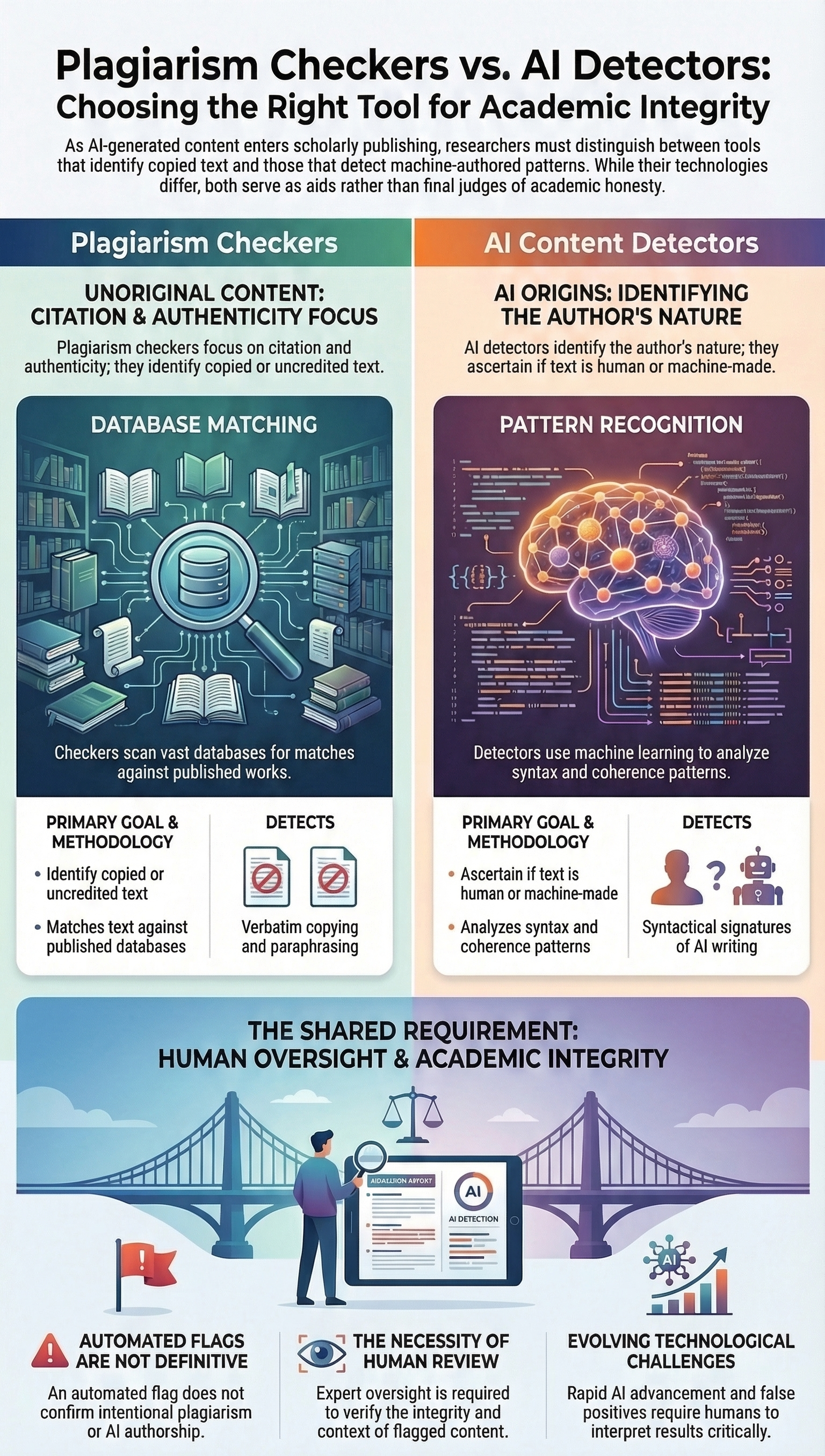
The academic world is currently facing a pivotal shift. With the explosion of AI-generated content, students and lecturers are navigating a landscape where the lines between human and machine-written work are becoming increasingly blurred. To stay ahead, it’s vital to understand the two guardians of academic integrity: Plagiarism Checkers and AI Content Detectors.
The Great Divide: Who is Who?
While they might seem similar, these tools have very different missions:
- Plagiarism Checkers: These are the authenticity hunters. They focus on whether the content was copied from existing work without proper credit.
- AI Content Detectors: These are the origin seekers. They don’t care if the work is “original” in the traditional sense; they only care if a human or a machine wrote it.
Under the Hood: How They Spot the Difference
- The Database Matcher: Plagiarism checkers (like Turnitin) compare your document against a massive database of books, journals, and websites. They look for exact matches, paraphrased text, and even sneaky tricks like hidden characters or synonym swapping.
- The Pattern Recognizer: AI detectors look for mathematical signatures. AI tends to follow specific syntactical structures and coherence patterns that differ from natural human writing. Machine learning models are trained to spot these robotic footprints.
The “Gotchas”: Why Machines Aren’t Perfect
Both lecturers and students need to remember that automated flags are not final verdicts.
- False Positives: Plagiarism checkers sometimes flag “common knowledge” or coincidental phrases as unoriginal.
- The AI Arms Race: As AI becomes more sophisticated, it gets harder for detectors to keep up. Some AI can even synthesize info so well that it mirrors the structure of copyrighted ideas without using the same words.
The Golden Rules for the Modern Classroom
To use technology without losing your integrity, follow these essential guidelines:
- AI is your Assistant, Not your Ghostwriter: Use AI for data analysis or initial brainstorming, but the critical thinking and scholarly insight must be yours.
- Transparency is Non-Negotiable: Always disclose if and how you used AI in your research process.
- Cite Meticulously: If in doubt, cite it! This includes ideas inspired by or generated by AI tools.
- The Human Touch: Always perform a human review. Never rely solely on a software report to judge a student’s work or a researcher’s integrity.
The Bottom Line
In this era of digital scholarship, tools like Turnitin, etc. can help you achieve “human precision at machine speed.” However, the goal isn’t just to pass a detector—it’s to uphold the highest standards of honesty and academic excellence of humans.
© mhsantosa (2026)
 Technology and Innovation in ELT