I’d like to share my key take aways of this article. Sam, C. Y. (2026). AI literacy in an uncertain world. Journal of Applied Learning & Teaching, 9(1). https://doi.org/10.53761/jalt.2026.9.1.1
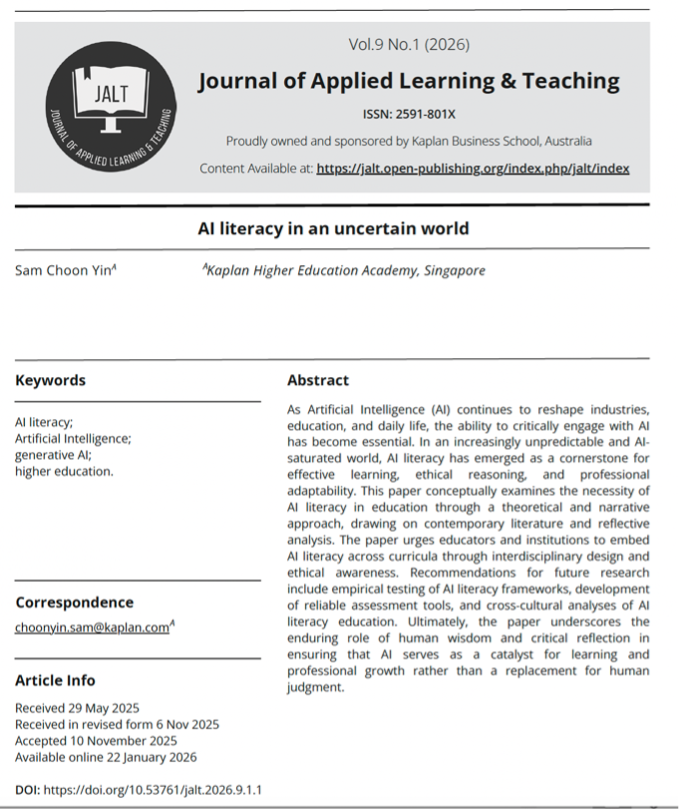
1/ AI literacy is no longer optional—it’s the cornerstone of modern education. As AI reshapes our world, being “AI literate” means moving beyond basic technical skills to embrace critical evaluation and ethical reasoning.
2/ What is AI Literacy? It’s more than just digital fluency. While digital literacy helps you use tools, AI literacy enables you to understand how intelligent systems work, recognize their biases, and question their impact on society.
3/ Key Takeaway 1: Capabilities vs. Limits AI is a “transformative force” in personalized learning and data processing, but it has a hard ceiling. It excels at fixed rules (like chess) but struggles with “uncertainty,” empathy, and moral judgment.
4/ Key Takeaway 2: The Risk of “Cognitive Atrophy” Over-reliance on AI can lead to AI-induced cognitive atrophy (AICICA), where students outsource critical thinking and memory to machines. The goal must be to augment human judgment, not replace it.
5/ Key Takeaway 3: Rethinking the Classroom Leading universities (like UF, NUS, and Nanjing University) are already embedding AI across curricula. The future is a hybrid model: using AI for routine tasks while prioritizing human-centered inquiry and reflection.
6/ Frameworks for Success To integrate AI effectively, educators can look to the Zhou and Schofield (2024) framework:
- Know and understand AI basics.
- Use and apply AI for problem-solving.
- Evaluate and create critically.
- Focus on AI Ethics.
7/ The Path Forward: Future Research Despite our progress, the sources highlight significant gaps. To move forward, future research should prioritize:
- Empirical Testing: Validating AI literacy frameworks in real-world classrooms.
- New Assessment Tools: Developing reliable ways to measure AI literacy and address the “wicked problem” of AI-assisted cheating.
- Cross-Cultural Analysis: Understanding how different global values (e.g., collective responsibility vs. individual inquiry) shape AI education.
8/ Final Thought: AI should be a catalyst for learning, not a substitute for human wisdom. By fostering AI literacy, we ensure technology serves human values and intellectual growth.
Happy reading ^^
#AILiteracy #EdTech #HigherEd #FutureOfLearning
(c) mhsantosa (2026)

