I’d like to share my key takeaways from this interesting report on “Generative Artificial Intelligence in Secondary Education” (2025)
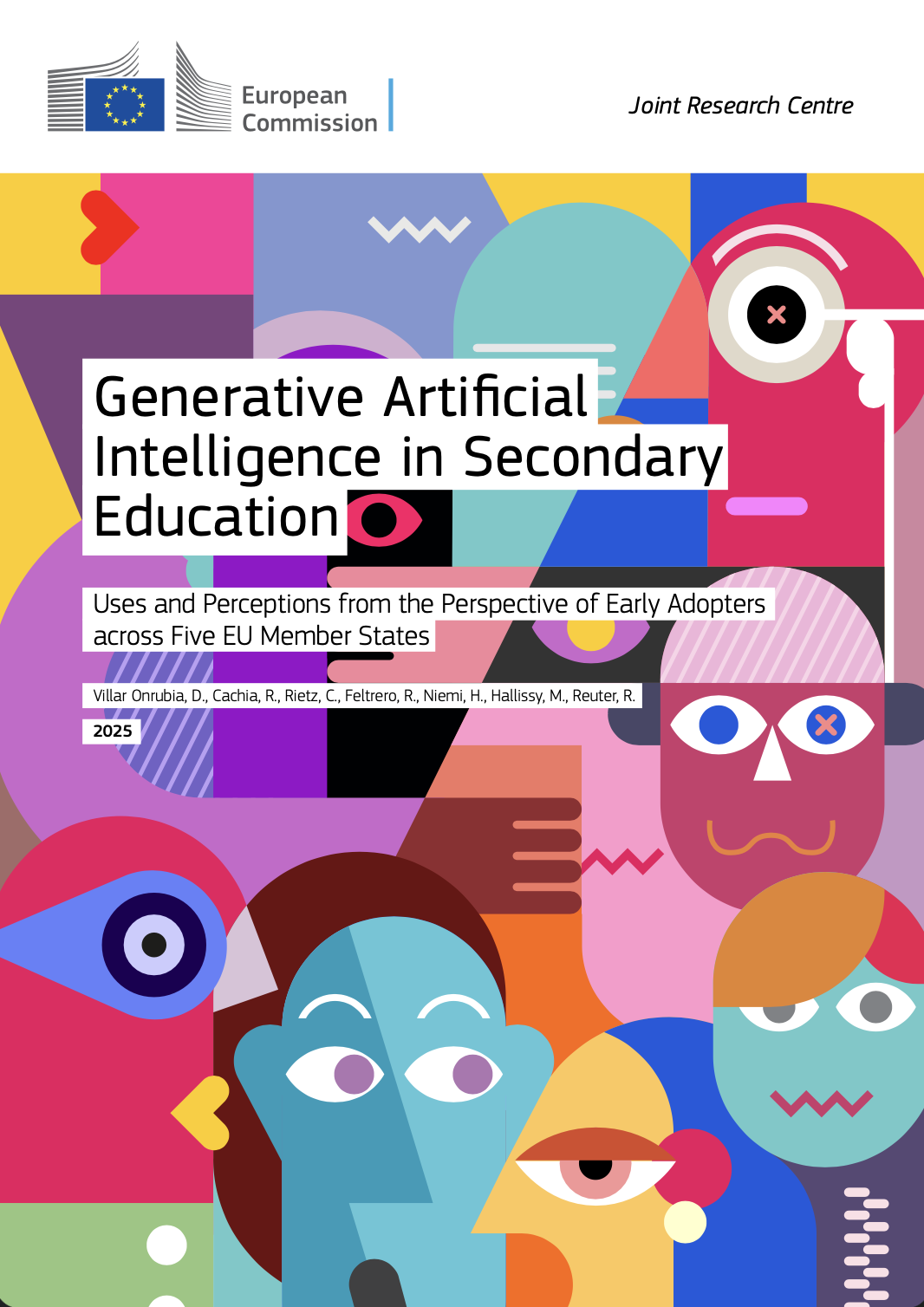
1/ Just finished reviewing the JRC report on Generative AI (GenAI) in secondary education, which explores its early adoption across Finland, Germany, Ireland, Luxembourg, and Spain. Here are the main takeaways and a look at what the report gets right—and what’s still missing.
2/ One of the biggest takeaways is that students are often ahead of their teachers, using GenAI as a personal assistant for summarizing complex topics, brainstorming, and simulating exams. While teachers use it for lesson planning, they expressed more caution regarding academic integrity and long-term learning impacts.
3/ The report highlights how GenAI can personalize learning at scale. For example, teachers are using it to create “sassy” writing buddies to engage unmotivated students or to simulate real-world scenarios like ordering coffee in a foreign language. It also offers significant workload relief for administrative tasks and resource creation.
4/ In Humanities, GenAI helps students overcome the “fear of the blank page” and sparks artistic exploration. In STEM, it’s being used to generate datasets for analysis and help students articulate coding problems, shifting the focus from the final answer to the problem-solving process.
5/ A major strength of the findings is the call to move from product-oriented to process-oriented assessment. Since AI can easily write an essay, educators are looking toward oral exams, in-class discussions, and evaluating the “learning journey” rather than just the final result.
6/ The report itself admits that wider ethical concerns were largely overlooked by the participants. While users worried about cheating and data privacy, they almost entirely ignored the environmental impact of AI, copyright infringement in model training, and the labor conditions of data annotators in the Global South.
7/ Because this was an exploratory study focused on early adopters, the findings cannot be generalized to the entire EU or even the individual countries involved. There is also a noted lack of scientific evidence on the long-term effectiveness of GenAI-based educational interventions.
8/ The report concludes that AI literacy must be embedded in the formal curriculum and teacher training. We need clear national policies and updated infrastructure to ensure the digital divide doesn’t widen, giving all students equitable access to these powerful tools.
9/ More details of the report: Villar-Onrubia, D., Cachia, R., Rietz, C., Feltrero, R., Niemi, H., Hallissy, M., & Reuter, R. (2025). Generative Artificial Intelligence in secondary education: Uses and perceptions from the perspective of early adopters across five EU Member States (Report No. JRC144345). Publications Office of the European Union. https://doi.org/10.2760/8636621
10/ You can also access and download the full report at the following URL: https://data.europa.eu/doi/10.2760/8636621
11/ Happy reading ^^
(c) mhsantosa (2026)
 Technology and Innovation in ELT