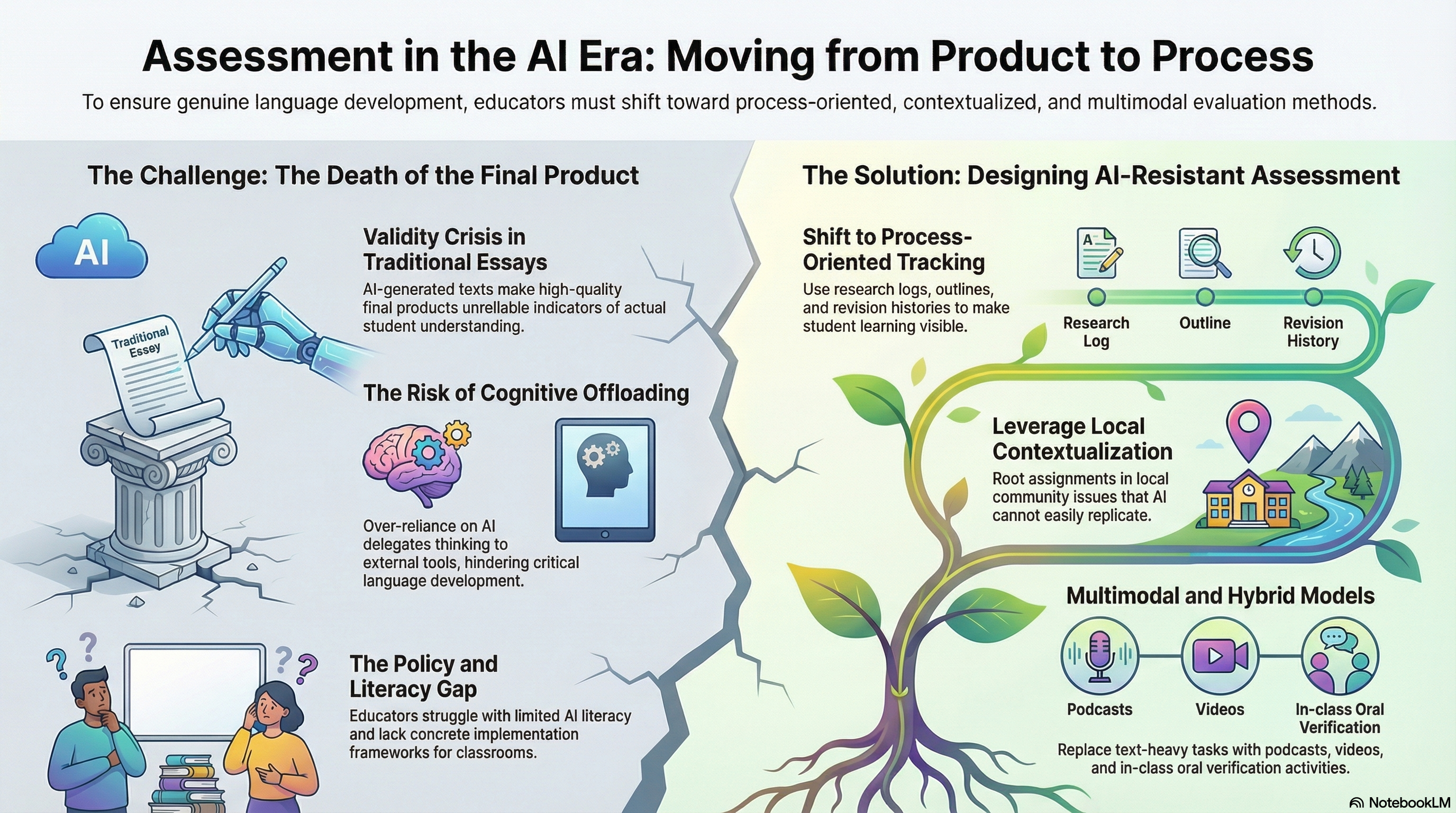
The rapid emergence of Generative AI has fundamentally disrupted traditional, product-based assessments like essays, challenging the validity and reliability of established evaluation methods within the Indonesian EFL context. How to respond to this phenomenon? How do we assess students in the age of Generative AI?
1/ In the Indonesian EFL context, traditional assessments like essays are being disrupted by high-quality AI-generated text, challenging our views on validity and reliability.
2/ While the Indonesian government encourages ethical AI use, current guidelines often lack concrete implementation frameworks for the classroom. This leaves many educators uncertain about how to move from theory to practice.
3/ Teacher readiness is a major hurdle. Limited AI literacy often leads to two extremes: attempting to ban AI entirely or allowing it without adjusting assessment design, which risks enabling shallow learning.
4/ On the student side, we see cognitive offloading – using AI superficially to complete tasks quickly rather than to enhance understanding. In language learning, this is critical because proficiency requires active cognitive effort.
5/ The fix requires a shift from product-based to process-oriented assessment. Instead of just grading a final essay, educators should track the journey through research logs, drafts, and revision histories.
6/ Context is key, as AI often lacks access to specific classroom experiences or local knowledge. Designing assignments rooted in local community issues or unique cultural practices makes AI-generated responses much less effective.
7/ Using multimodal assessment, such as podcasts or videos, demands a deeper level of understanding and communication. These formats align with communicative language teaching and make it harder to rely solely on AI.
8/ AI-generated outputs can be used as objects of critique to foster higher-order thinking. This strategy encourages students to evaluate AI for accuracy and coherence, building essential critical AI literacy.
9/ Hybrid models can combine AI tasks with in-class verification activities like interviews or oral presentations. Promoting transparency through AI-use declarations helps shift the focus from prohibition to responsible, ethical use.
10/ The rise of AI presents an urgent need to transform assessment from final outputs to process-oriented and contextualized practices. By integrating AI thoughtfully, educators can create more authentic and meaningful assessment systems for the digital age.
11/ Happy reading ^^
© mhsantosa (2026)
 Technology and Innovation in ELT