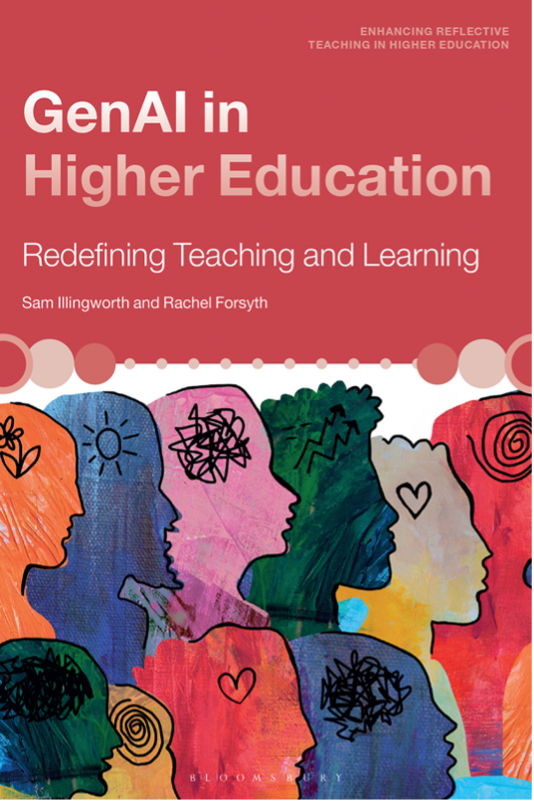
I’d like to share my piece on this great book by Illingworth, S. and Forsyth, R. (2026). GenAI in Higher Education: Redefning Teaching and Learning. Bloomsburry Academic. FREE DOWNLOAD.
1/ The book GenAI in Higher Education: Redefining Teaching and Learning by Sam Illingworth and Rachel Forsyth (2026), offer a comprehensive guide for educators navigating the integration of Generative Artificial Intelligence (GenAI) into university settings.
2/ The authors argue that while GenAI is a powerful tool for efficiency and creativity, it must be used to supplement rather than replace the human relationships and critical judgment central to education.
3/ Higher Ed is at a crossroads with Generative AI. In their book “GenAI in Higher Education,” Sam Illingworth and Rachel Forsyth provide a guide for navigating this “uncharted territory” while upholding academic rigor. Here is how we can responsibly integrate these tools.
4/ The authors argue that any AI integration must be built on four foundational principles: Student-Centeredness: Engaging with quality knowledge; Trust: Fostering a safe environment for authentic expression; Relevance: Connecting concepts to real life; Agency: Giving students and teachers autonomy.
5/ What exactly is GenAI? It is a subset of AI that focuses on generating new content (text, images, audio) rather than just retrieving data. It uses Large Language Models (LLMs) to predict the next sequence in a series based on patterns. Effectively, it’s a “sophisticated guessing machine.”
6/ Understanding the Technology. The sources define GenAI as a subset of artificial intelligence that focuses on generating new content (text, images, audio, video) rather than simply retrieving pre-existing data.
- Large Language Models (LLMs): These systems, such as GPT-4, operate by analyzing patterns in massive datasets and predicting the next sequence in a series (e.g., the next word in a sentence).
- A “Sophisticated Guessing Machine”: Because GenAI generates outputs based on statistical probability rather than a human-like understanding of “truth,” it can produce “hallucinations”—plausible but entirely false information.
7/ How can institutions organize AI use? The “Four D’s” framework is a great start: Dreaming: Creative brainstorming; Drudgery: Automating repetitive admin tasks; Design: Creating teaching materials; Development: Strategic policy and planning.
8/ Dreaming: Using GenAI for creative brainstorming and exploring innovative solutions.
9/ Drudgery: Automating repetitive administrative tasks like drafting emails or summarizing long reports.
10/ Design: Creating teaching materials, such as visual aids and presentation slides.
11/ Development: Strategic uses, such as drafting institutional policies or preparing funding proposals.
12/ Core Principles for Integration. The authors propose that the use of GenAI in higher education should be built upon four foundational pillars:
- Student-Centeredness: Ensuring students continue to engage with valued knowledge, standards, and expertise.
- Trust: Creating an open environment where students feel safe to take risks and express themselves authentically.
- Relevance: Connecting academic concepts to students’ lives and the broader social and professional contexts.
- Agency: Empowering both learners and educators with the autonomy to shape their educational journeys.
13/ A major caution: “Hallucinations.” Because GenAI predicts probability rather than “knowing” truth, it often produces plausible but false information. Educators and students must verify and cross-check every output.
14/ What about academic integrity? AI detection tools are currently unreliable and frequently produce false positives, which can unfairly penalize non-native English speakers. The sources suggest shifting toward “authentic assessment”—tasks that mirror real-world challenges and require critical reflection.
15/ We must also face the ethical and social costs. GenAI training data often reflects dominant Western narratives, leading to potential bias and “linguistic white supremacy.” Furthermore, the computing power required has a significant environmental footprint in energy and water use.
16/ The bottom line? GenAI is a developing set of capabilities that can empower education, but it cannot substitute for human relationships, judgment, and care. These human elements must remain at the heart of the university experience.
17/ The book is free. You can download it at https://www.taylorfrancis.com/books/oa-mono/10.4324/9781003459026/generative-ai-higher-education-cecilia-ka-yuk-chan-tom-colloton
18/ Or go to https://doi.org/10.5040/9781350535824
19/ Happy reading ^^
(c) mhsantosa (2026)
 Technology and Innovation in ELT