Introduction
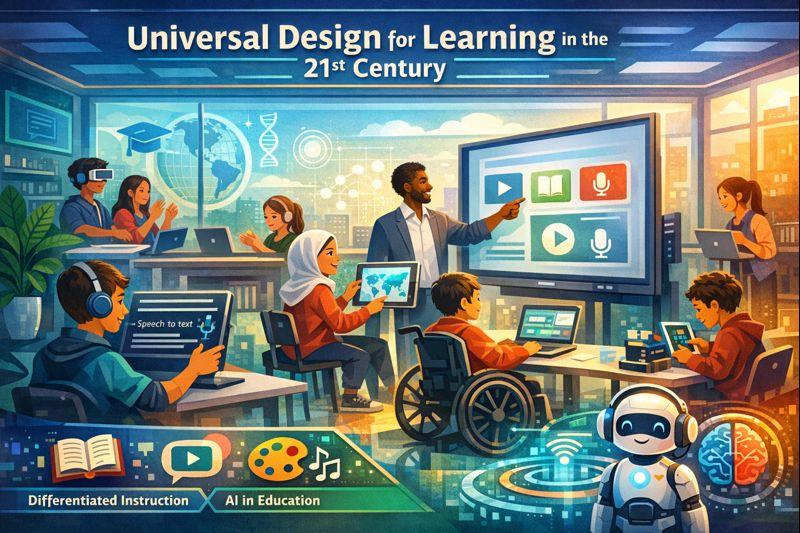
Education in the 21st century is situated within a rapidly evolving sociotechnical landscape, characterized by increasing globalization, digital transformation, and diverse learner populations. Traditional one-size-fits-all approaches to teaching are no longer adequate to meet the complex needs of contemporary classrooms. The growing diversity of learners—culturally, linguistically, cognitively, and socioeconomically—requires pedagogical approaches that ensure equitable access to learning opportunities. Within this context, Universal Design for Learning (UDL) has emerged as a powerful framework to guide educators toward creating flexible, accessible, and inclusive learning environments. Grounded in cognitive neuroscience and informed by inclusive education research, UDL offers principles and guidelines that help teachers design instruction for variability rather than treating difference as a problem requiring accommodation.
Understanding Universal Design for Learning
Universal Design for Learning originates from the architectural concept of universal design, which advocates designing environments and products usable by all people to the greatest extent possible without requiring adaptation. In the educational context, UDL was developed by CAST (Center for Applied Special Technology) in the 1990s, drawing on cognitive neuroscience research to propose an instructional design approach informed by the ways human brains learn.
UDL is built upon three primary principles, each aligned with a specific brain network:
- Multiple Means of Engagement (Affective Network) – addressing motivation, interest, and emotional investment in learning.
- Multiple Means of Representation (Recognition Network) – providing diverse ways of presenting content so learners can process and understand information.
- Multiple Means of Action and Expression (Strategic Network) – enabling learners to demonstrate their understanding in flexible ways.
What distinguishes UDL from other frameworks is its proactive design. Instead of retrofitting instruction when learners struggle, UDL encourages teachers to anticipate variability and design lessons that are flexible from the outset. In today’s educational systems, where the diversity among learners is increasingly recognized and celebrated, UDL provides a blueprint for equitable and inclusive teaching.
Inclusivity in Today’s Educational Landscape
The concept of inclusivity has evolved significantly over the past decades, moving from a narrow focus on integrating students with disabilities into mainstream classrooms to a broader understanding that all learners have unique strengths and needs. Today’s inclusive education recognizes variability across linguistic background, socioeconomic status, neurodiversity, gender identity, learning pace, emotional regulation, motivation levels, and life experiences.
1. Diversity as the Norm
In many 21st-century classrooms, diversity is no longer the exception—it is the standard. Migration, globalization, multiculturalism, and better identification of learning differences have increased learner heterogeneity. This diversity includes:
- English language learners
- Neurodivergent students (ADHD, ASD, dyslexia, etc.)
- Students with physical or sensory impairments
- Gifted or accelerated learners
- Students from marginalized or underserved communities
UDL recognizes this diversity without categorizing students into fixed groups. Instead, it positions variability as predictable and therefore something educators can design for.
2. Inclusion as Pedagogical and Ethical Imperative
Inclusive education in the 21st century is guided by human rights frameworks, including the UN Convention on the Rights of Persons with Disabilities (CRPD) and UNESCO’s Education for All initiative. These global declarations affirm that all learners have the right to equitable and meaningful participation.
UDL directly supports these commitments by removing systemic barriers that often exclude or marginalize certain learners. Its focus on flexibility and proactive accommodations aligns with inclusive values, ensuring that educational systems do not only “allow” diverse learners to participate but actively design environments that invite and empower them.
Universal Design for Learning and Differentiated Instruction
While UDL and Differentiated Instruction (DI) share common goals—addressing learner variability and promoting equity—UDL operates at a more foundational level: designing the environment, whereas DI focuses on adapting the instruction.
UDL: Systems-Level Flexibility
UDL ensures that curricula, materials, and environments are inherently flexible. For example, a teacher may present content using videos, readings, audio recordings, and interactive simulations to reach different learners. Assessments may also be offered in diverse formats such as oral presentations, written essays, or multimedia compositions.
This built-in flexibility reduces the need for reactive differentiation or one-on-one accommodations.
Differentiated Instruction: Learner-Specific Responses
DI, on the other hand, typically involves modifying instruction to meet the needs of specific learners or groups, such as:
- Tiered assignments
- Small-group interventions
- Advanced challenges for gifted learners
- Modified assessments
DI is essential, but can become burdensome if the learning environment itself is inflexible. Therefore, combining UDL (proactive design) with DI (responsive personalization) creates a robust pedagogical approach that maximizes equity.
How UDL Enhances Differentiated Instruction
UDL provides the structure and flexibility that make differentiation more feasible:
- With multiple formats of content, DI becomes less time-consuming.
- When learners have choices in assessments, DI can target deeper learning rather than format changes.
- UDL creates a culture of learner empowerment, encouraging students to co-design their learning pathways.
Thus, UDL does not replace DI but strengthens and expands its impact.
UDL in the 21st Century: Technology, Digital Literacies, and Global Competencies
The demands placed on 21st-century learners include collaboration, critical thinking, communication, creativity, digital fluency, and global citizenship. UDL aligns seamlessly with these competencies because it emphasizes flexibility, collaboration, and learner agency.
1. Digital Tools as Enablers of UDL
In the 21st century, education is deeply intertwined with technology. Digital tools provide natural avenues for implementing UDL:
- Text-to-speech and speech-to-text tools support literacy.
- Videos, animations, and simulations offer multimodal representation.
- Learning management systems allow for personalized pacing and choice.
- Collaborative platforms facilitate group work and peer learning.
Technology amplifies UDL by making flexible design more accessible to teachers and students.
2. Equity in the Digital Age
While technology expands possibilities, it also introduces new inequities such as unequal access to devices and digital literacy gaps. UDL addresses these concerns by promoting accessibility, offering multiple formats, and emphasizing flexible modes of engagement. As digital skills become more essential for participation in society, UDL ensures that these competencies are attainable for all learners.
UDL and the Artificial Intelligence Era
Artificial intelligence is reshaping education, presenting both opportunities and challenges. AI-powered tools can enhance UDL in significant ways but also raise ethical considerations.
1. AI as a Tool for Personalization
AI technologies like intelligent tutoring systems, language-learning platforms, adaptive assessments, and digital assistants can analyze learner behaviors and provide personalized feedback. This capability aligns with UDL by supporting:
- Customized pacing
- Adaptive practice activities
- Real-time feedback
- Learning recommendations based on student performance patterns
For example, AI-powered language learning apps (e.g., Duolingo, Grammarly, or ChatGPT-based tutoring systems) can scaffold vocabulary, grammar, pronunciation, and comprehension based on learner needs.
2. Reducing Cognitive Load
AI tools such as summarizers, text enhancement applications, and note-generators help students process information more efficiently. These features support UDL’s focus on reducing barriers to representation and engagement.
3. Enhancing Action and Expression
Learners can use AI tools to express learning in multiple formats:
- AI-driven video creators
- Visual storyboarding tools
- Interactive simulations
- Automated speech recognition
- Multilingual translation tools
These technological affordances widen students’ expressive possibilities, allowing them to demonstrate comprehension in personally meaningful ways.
4. Ethical Considerations
However, AI integration requires careful ethical reflection. Issues related to data privacy, academic integrity, algorithmic bias, and student agency are central concerns. UDL offers a human-centered framework for integrating AI responsibly. Its emphasis on learner autonomy, equitable access, and transparent design aligns with ethical AI principles.
Challenges in Implementing UDL in 21st-Century Schools
Despite its promise, UDL implementation faces several barriers:
1. Teacher Training and Workload
UDL requires professional development in design thinking, technology integration, and inclusive practices. Many teachers feel overwhelmed by the shift toward proactive and flexible design.
2. Structural Constraints
Standardized assessments, rigid curricula, and limited resources can hinder UDL adoption. Without systemic support, UDL risks being perceived as an add-on rather than a foundational framework.
3. Access to Technology
Digital inequities persist globally, affecting the implementation of technology-rich UDL environments. Addressing these barriers requires policy interventions and investment in digital infrastructure.
Despite these challenges, increasing global emphasis on inclusivity, accessibility, and digital literacy is accelerating UDL adoption. Nations and institutions are integrating UDL into teacher education programs, accreditation standards, and inclusive education policies.
The Future of Inclusive Education: UDL, DI, and AI in Harmony
The future of inclusive education lies in leveraging the synergy between UDL, differentiated instruction, and artificial intelligence. These three components, when integrated, create a powerful ecosystem that supports learner agency, diversity, and equitable participation.
UDL provides the design foundation
Ensuring that curricula and environments are accessible and flexible from the start.
Differentiated Instruction provides the responsive adaptations
Addressing unique learner needs through targeted support.
AI provides the adaptive technological scaffolding
Offering personalized pathways, real-time feedback, and multimodal resources.
Together, they reshape educational landscapes to move beyond the constraints of rigid instruction and embrace a model where every learner’s potential can be realized.
Conclusion
Universal Design for Learning represents a visionary approach to education that aligns seamlessly with the values, challenges, and opportunities of the 21st century. As classrooms become increasingly diverse and as technology—particularly artificial intelligence—transforms the ways we teach and learn, UDL offers a flexible, research-informed framework for creating equitable and inclusive learning environments.
By connecting UDL with differentiated instruction and embracing the possibilities of AI, educators can foster learning spaces that honor variability, promote engagement, and empower all students to thrive. The future of education depends not only on technological advancements but also on a deep commitment to access, inclusion, and human-centered design. UDL, grounded in these principles, stands as a cornerstone for building an educational system that is responsive, ethical, and prepared for the complexities of the modern world.
(c)mhsantosa (2025)
 Technology and Innovation in ELT