
Generative AI (GenAI) tools are rapidly evolving, offering exciting opportunities for teaching and learning. However, with so many tools available, it is important to choose wisely. By using the 5 Ps framework—Purpose, Policy, Product, People, and Presence—you can evaluate any GenAI tool effectively. Here’s how, with examples specifically tailored for English as a Foreign Language (EFL) classrooms.
1. Purpose: Does the Tool Meet Your Teaching Goals?
Every GenAI tool has a specific function. Before using one, ensure its purpose aligns with your teaching goals.
Questions to consider:
– What does the tool do? (e.g., text generation, image creation, pronunciation practice)
– Does it address your students’ needs effectively?
– Can it complement your teaching strategies?
EFL Example:
Imagine you discover a tool that generates conversation scripts for role-play. To evaluate its purpose, check if the scripts are at your students’ language proficiency level and culturally appropriate. For instance, if teaching intermediate students about ordering food, the tool should generate dialogues that balance challenge and comprehensibility.
2. Policy: Is the Tool Safe and Ethical?
A tool’s policies ensure data security, fairness, and ethical use. Teachers must be mindful of these before introducing GenAI tools in class.
Questions to consider:
– Does the tool protect user data?
– Is it transparent about how it handles bias in its training data?
– How does it handle copyright?
EFL Example:
You want to use an AI tool that evaluates students’ writing. Beforehand, review the tool’s privacy policy to ensure it doesn’t store students’ essays without consent. Additionally, check how it avoids bias, ensuring fair feedback for learners from different linguistic backgrounds.
3. Product: What Does the Tool Produce?
Evaluate the quality, accuracy, and consistency of the tool’s output.
Questions to consider:
– Does it provide high-quality and relevant results?
– Does it avoid “hallucinations” (producing false or made-up information)?
– Can it adapt to repeated prompts or varying difficulty levels?
EFL Example:
You test a tool that generates vocabulary quizzes. Ask it to create a quiz about idioms. If it includes examples like “kick the bucket” but gives a literal definition (“to kick a container”), the tool may not yet be reliable for nuanced language teaching. Always double-check outputs before sharing with students.
4. People: How Involved Are Teachers and Students?
The best GenAI tools encourage human interaction rather than replacing it. Teachers and students must remain active participants.
Questions to consider:
– How user-friendly is the tool?
– Can you customize its output?
– Does it explain its suggestions clearly?
EFL Example:
Suppose you use a chatbot to help students practice speaking. The tool allows students to type or speak their responses and offers corrections. However, you must step in to explain the rationale behind corrections and ensure students don’t feel discouraged. Active teacher involvement helps students gain more from such tools.
5. Presence: Who Is Behind the Tool?
Investigate the developer’s reputation, tool accessibility, and long-term viability.
Questions to consider:
– Is the company behind the tool trustworthy?
– Are other teachers using it? What do they say?
– Is it affordable and accessible for students?
EFL Example:
You come across a tool for creating pronunciation exercises, but it’s only available via a costly subscription. While it may offer excellent features, consider alternatives that are equally effective but free, such as Google Text-to-Speech or YouTube videos. Accessibility matters for inclusive classrooms.
Using GenAI tools in EFL classrooms can revolutionize teaching and learning, but critical evaluation is key. By asking the right questions around Purpose, Policy, Product, People, and Presence, you can ensure these tools are safe, effective, and meaningful for your teaching.
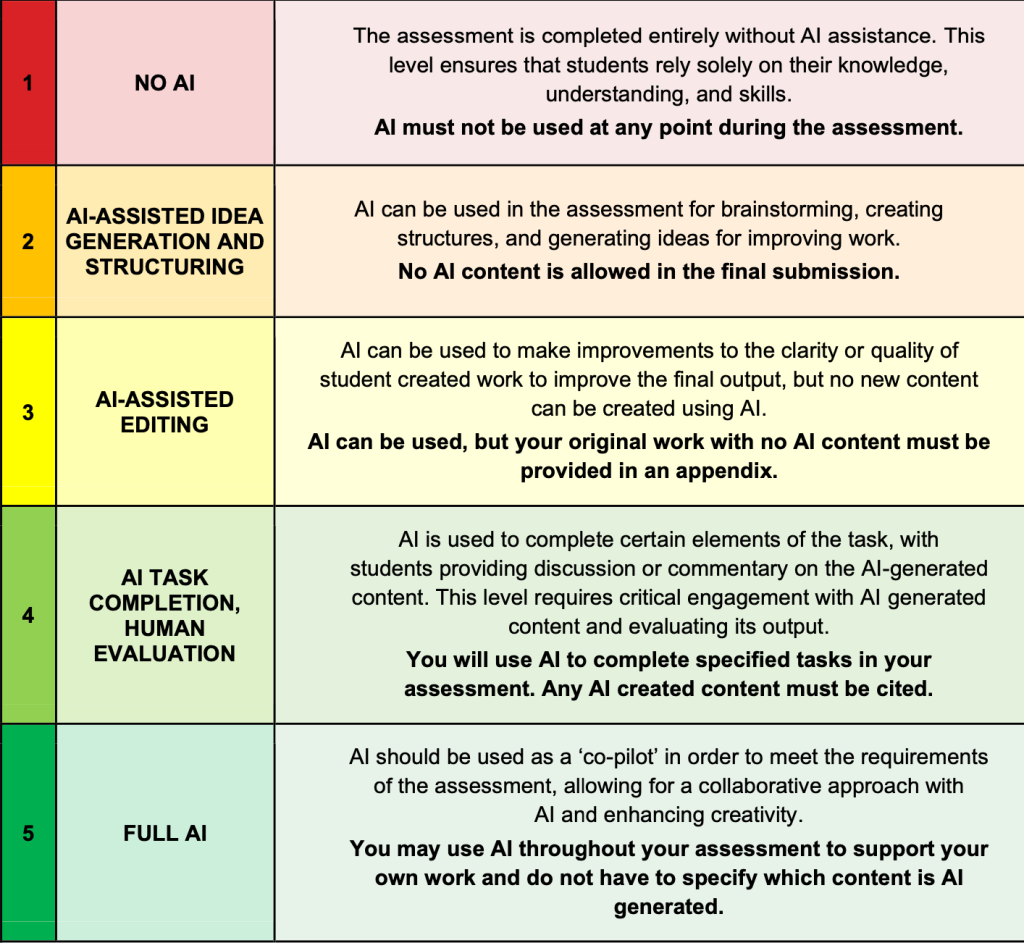
Note: You can also read Furze’s updated AI Assessment Scale (AIAS) here.
What do you think? Share your experience in the comments below!
@mhsantosa (2024)
 Technology and Innovation in ELT