I’d like to share the main key takeaways from this timely report by OECD entitled “OECD Digital Education Outlook 2026: Exploring Effective Uses of Generative AI in Education”, published by OECD in 2026.
1/ Generative AI (GenAI) is reshaping the educational landscape, beyond teaching and learning.
Unlike previous generations of educational technology, generative artificial intelligence (GenAI) is widely available at little or no cost and is often used independently of institutional oversight because of its user-friendly and highly adaptable nature. The OECD Digital Education Outlook 2026 reviews emerging studies indicating that GenAI can meaningfully support student learning when its use is guided by sound pedagogical principles. However, when GenAI is implemented or relied upon without appropriate instructional design, delegating tasks to the technology may improve task completion but does not necessarily lead to genuine learning outcomes. The report emphasises GenAI’s potential roles as a tutor, collaborative partner, and learning assistant, while also bringing together expert evidence and insights on the key design conditions required for its effective use in education.

2/ Successfully performing a task with GenAI does not automatically lead to learning
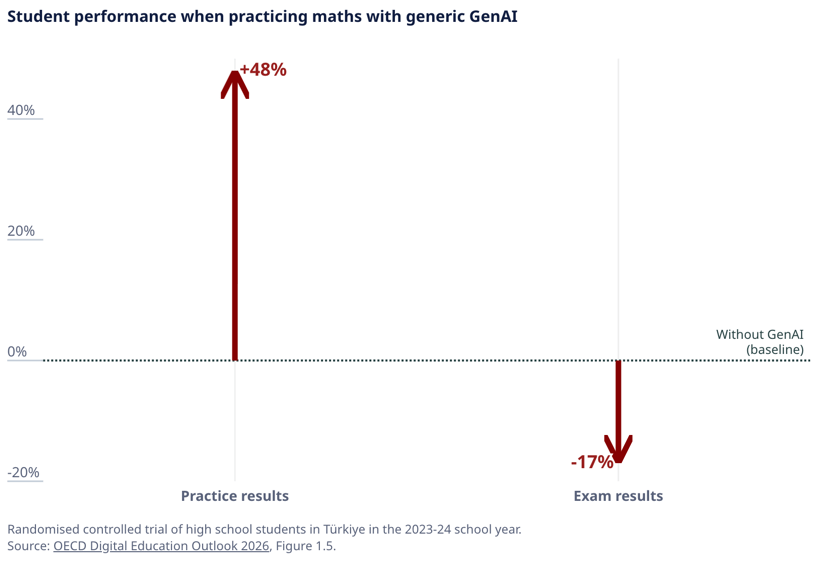
Recent research indicates that although general-purpose generative artificial intelligence (GenAI) tools can improve students’ task performance, these improvements do not automatically translate into deeper learning. When learners rely on general-purpose chatbots to handle cognitive processes, there is a risk of developing metacognitive dependence and reduced engagement, which may ultimately hinder long-term skill development. A number of studies show that students using such tools often produce higher-quality assignments compared to peers without access; however, this performance advantage tends to diminish—or even reverse—during examinations when GenAI support is no longer available. In contrast, educational GenAI applications that are intentionally designed or implemented with clear pedagogical goals are more likely to promote lasting learning improvements.
3/ Using GenAI with pedagogical intent can improve learning and foster skills like critical thinking, creativity and collaboration
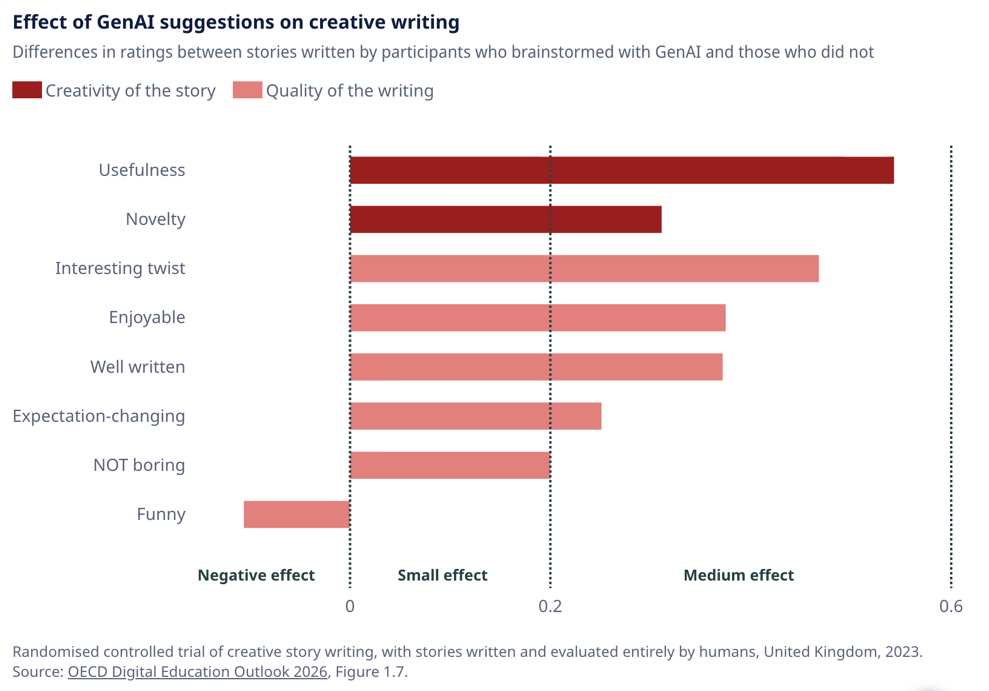
Generative artificial intelligence (GenAI) has the potential to enhance learning outcomes when it is applied with clear pedagogical intentions or when instructional approaches are redesigned to accommodate its presence. For instance, in collaborative learning environments grounded in learning science principles, GenAI tools can support deeper knowledge construction and help students develop stronger reasoning and argumentation skills. In addition, GenAI can enhance the effectiveness of conventional digital learning technologies by making them more interactive and responsive. Intelligent Tutoring Systems (ITS) powered by GenAI, for example, can evolve from rigid, pre-programmed tutors into adaptive pedagogical agents that engage learners through natural dialogue, ask probing questions, provide timely prompts, and adjust instructional strategies based on students’ needs.
4/ Educational GenAI can augment human teaching and tutoring while preserving teachers’ agency
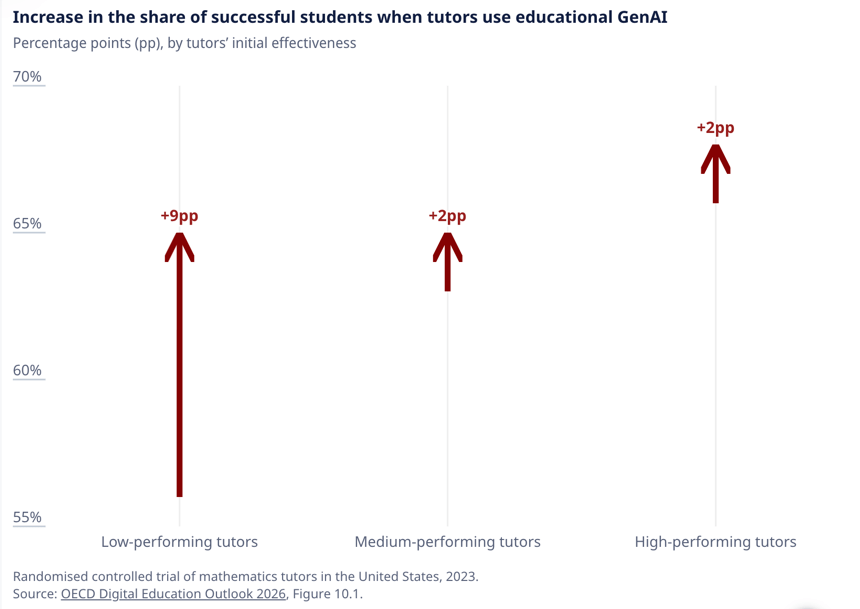
Growing empirical evidence shows that novice tutors can improve both the quality of their instructional support and students’ learning outcomes through the effective use of educational generative artificial intelligence (GenAI) tools. When teachers’ professional knowledge and experience are incorporated into the design and implementation process, GenAI can strengthen instructional capacity, producing learning benefits that neither educators nor AI systems could achieve on their own. Collaborative co-design involving teachers and end users therefore represents an important approach to ensuring that GenAI tools are pedagogically meaningful and capable of delivering genuine educational value.
6/ GenAI can boost scientific research and help streamline institutional operations
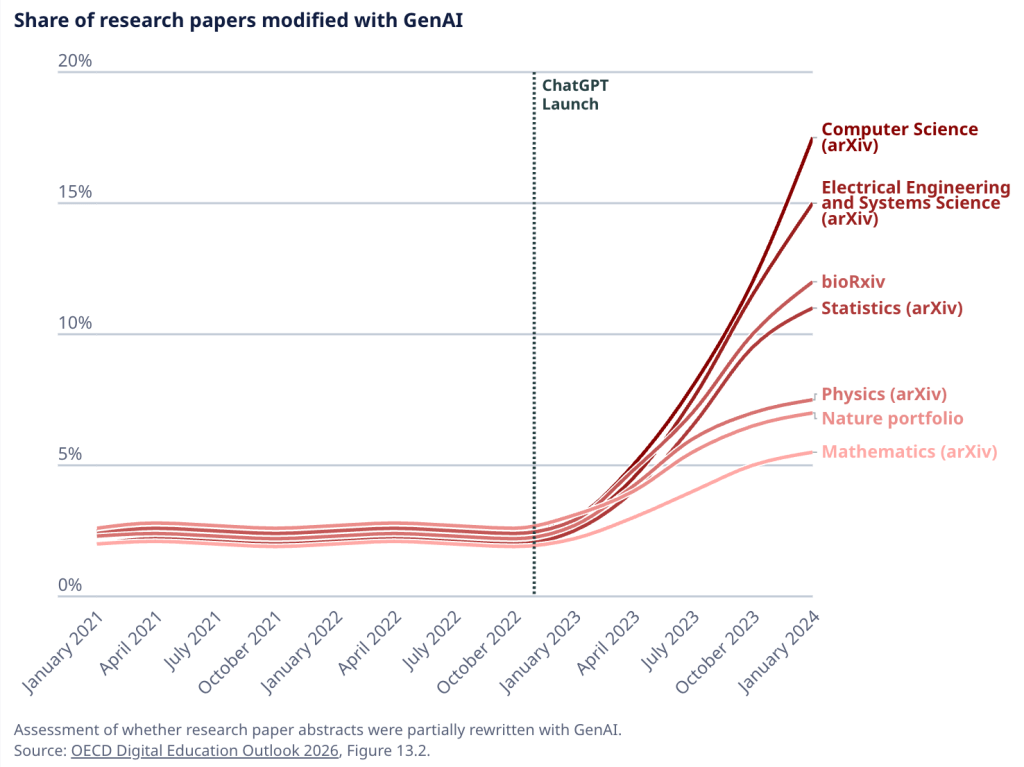
Generative artificial intelligence (GenAI) is increasingly being integrated into scientific research practices, with the potential to significantly transform education research. Since the introduction of ChatGPT, a growing number of researchers have begun using GenAI tools not only to obtain feedback on academic manuscripts but also to support various stages of the research process. Beyond research activities, school administrators are also experiencing shifts in their professional responsibilities, as GenAI helps streamline institutional and system-level management through more efficient backend operations. These tools can assist in developing standardised assessment materials, evaluating curriculum alignment, and organising as well as categorising educational resources. When carefully optimised, GenAI systems can additionally provide continuous study and career guidance, offering accessible support at any time.
7/ What can governments and other education stakeholders do?
- Foster human-centred teaching and learning with GenAI
Learning and teaching should primarily aim to develop valued human knowledge and skills such as independent thinking and foundational skills across subjects, without GenAI, with educational GenAI, and then with general-purpose GenAI. GenAI should be used selectively and purposefully for pedagogical reasons to enrich learning and not replace cognitive effort or weaken the human relationships at the heart of education.
- Invest in educational GenAI research and development
As general-purpose GenAI tools are not designed specifically for learning, education systems should incentivise the development of tools that aim to enhance teaching and learning. Investing in educational GenAI grounded in learning science, co-created with teachers and learners, and supported by rigorous research on their effectiveness can open new possibilities for educational improvement. Governments and education stakeholders should also co-operate to research beneficial uses of GenAI in education.
- Shape an enabling policy environment for trustworthy GenAI
Jurisdictions should ensure that policy and regulatory frameworks protect learners and support learning while enabling innovation. Combined with ongoing stakeholder dialogue, clear expectations on privacy, safety, bias testing, age-appropriateness, transparency and alignment with educational objectives can create an enabling environment for the trustworthy and meaningful use of GenAI in education.
- Support an effective GenAI infrastructure for all
Jurisdictions should ensure equitable digital infrastructure and support (devices, connectivity, digital resources and professional learning opportunities) so that all students and teachers can benefit from GenAI. Providing curriculum-aligned GenAI resources, alternative solutions where divides persist, and sustained professional learning, enables effective, inclusive and meaningful uses of GenAI in education.
8/ Read more here: OECD (2026), OECD Digital Education Outlook 2026: Exploring Effective Uses of Generative AI in Education, OECD Publishing, Paris, https://doi.org/10.1787/062a7394-en. URL: https://www.oecd.org/en/publications/oecd-digital-education-outlook-2026_062a7394-en.html
9/ Happy reading ^^
(c) mhsantosa (2026)
 Technology and Innovation in ELT